


Gui
#Header
#include <gui/gui.h>
#Functions
| void | gui_start (void) |
| void | gui_finish (void) |
| void | gui_dpi_aware (...) |
| void | gui_respack (...) |
| void | gui_language (...) |
| const char_t* | gui_text (...) |
| const Image* | gui_image (...) |
| const byte_t* | gui_file (...) |
| bool_t | gui_dark_mode (void) |
| color_t | gui_alt_color (...) |
| color_t | gui_label_color (void) |
| color_t | gui_view_color (void) |
| color_t | gui_line_color (void) |
| color_t | gui_link_color (void) |
| color_t | gui_border_color (void) |
| device_t | gui_device (void) |
| S2Df | gui_resolution (void) |
| R2Df | gui_workarea (void) |
| V2Df | gui_mouse_pos (void) |
| void | gui_update (...) |
| void | gui_OnThemeChanged (...) |
| void | gui_update_transitions (...) |
| void | gui_OnNotification (...) |
| void | gui_OnIdle (...) |
| uint32_t | gui_info_window (...) |
| type* | evbind_object (...) |
| bool_t | evbind_modify (...) |
#Types and Constants
| enum | gui_orient_t |
| enum | gui_pos_t |
| enum | gui_state_t |
| enum | gui_mouse_t |
| enum | gui_cursor_t |
| enum | gui_close_t |
| enum | gui_scale_t |
| enum | gui_scroll_t |
| enum | gui_focus_t |
| enum | gui_tab_t |
| enum | gui_event_t |
| enum | split_mode_t |
| enum | window_flag_t |
| enum | gui_notif_t |
| struct | GuiControl |
| struct | Label |
| struct | Button |
| struct | PopUp |
| struct | Edit |
| struct | Combo |
| struct | Tabs |
| struct | ListBox |
| struct | UpDown |
| struct | Slider |
| struct | Progress |
| struct | View |
| struct | TextView |
| struct | WebView |
| struct | ImageView |
| struct | TableView |
| struct | SplitView |
| struct | Layout |
| struct | Cell |
| struct | Panel |
| struct | Line |
| struct | Window |
| struct | Menu |
| struct | MenuItem |
| struct | EvButton |
| struct | EvSlider |
| struct | EvText |
| struct | EvTextFilter |
| struct | EvDraw |
| struct | EvMouse |
| struct | EvWheel |
| struct | EvKey |
| struct | EvPos |
| struct | EvSize |
| struct | EvWinClose |
| struct | EvMenu |
| struct | EvScroll |
| struct | EvTbPos |
| struct | EvTbRow |
| struct | EvTbRect |
| struct | EvTbSel |
| struct | EvTbCell |
| struct | EvTbNode |
| struct | EvTbNodeInfo |
| struct | EvTbExpand |
| struct | FocusInfo |
The Gui library allows you to create graphical user interfaces in a simple and intuitive way. Only available for desktop applications for obvious reasons (Figure 1), unlike the rest of libraries that can also be used in command line applications.
Like Draw2D and Osbs Gui relies on the APIs of each operating system. In addition to the advantages already mentioned in these two cases, native access to interface elements will cause our programs to be fully integrated in the desktop and according to the visual theme present in each machine (Figure 2).
#1. Declarative composition
The Gui library moves away from the concept of treating windows (or dialog boxes) as an external resource of the program. On the contrary, these are created directly from the source code avoiding layout by visual editors (Figure 3). We must bear in mind that window managers use different fonts and templates, so specifying specific positions and sizes for the elements will not be portable between platforms (Figure 4). On the contrary, in Gui the controls are located in a virtual grid called Layout, which will calculate its location and final size at runtime and depending on the platform (Figure 5).
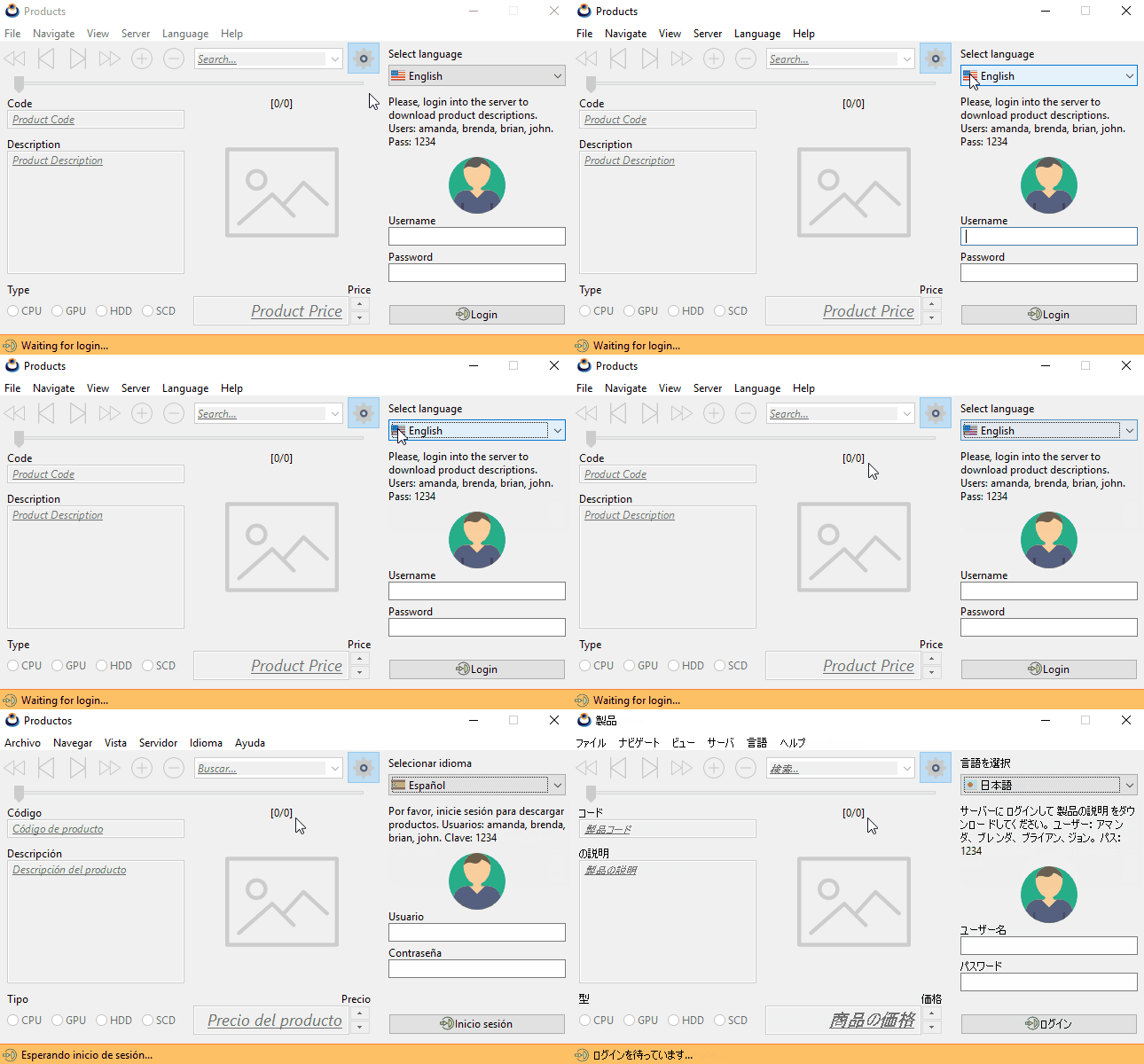
In addition, another relevant fact is that interfaces are living objects subject to constant changes. A clear example is the translations, which alter the location of the elements due to the new dimension of the text. Gui will adapt to these events automatically, recalculating positions and sizes to maintain a consistent layout. See Internationalization (i18n). Translations.
#2. Anatomy of a window.
In (Figure 6) we have the main parts of a window. Controls are the final elements with which the user interacts to enter data or launch actions. The views are rectangular regions of relatively large size where information is represented by text and graphics, being able to respond to keyboard or mouse events. Finally, all these elements will be grouped into panels and will be layout by layouts.
- GuiControl. Different types of controls and views.
- Layout. Virtual and invisible grid where the controls will be located.
- Window. Main window with title bar and frame.
- Menu. Drop-down list with options.
- MenuItem. Each of the menu items.
#3. Native backends
Gui ultimately relies on the native graphics API of each operating system: Win32 on Windows, AppKit on macOS and GTK+3 on Linux. Most of an application's code is fully portable across the three, but it is worth knowing some particularities of each backend.
#3.1. Windows (Win32)
Win32 is Windows' native API since its origins in the 1980s, a C interface built around messages and handles, with no object-oriented concepts. It is remarkably stable: an application compiled twenty years ago still runs unchanged on Windows 11. GDI (Graphics Device Interface) is its 2D drawing subsystem, on top of which NAppGUI builds windows and controls.
The native Windows API (Win32/GDI) always works in physical pixels, with no logical point concept of its own. NAppGUI activates Windows' Per-Monitor-v2 DPI-awareness mode (available since Windows 10), which allows it to know the real DPI of each monitor and receive immediate notification of any change, performing the relevant point-to-pixel conversions internally in Win32/GDI. See High-density displays (HiDPI).
#3.2. macOS (AppKit)
AppKit is macOS's native interface framework, a direct descendant of NeXTSTEP and part of Cocoa. Unlike Win32, it is designed around objects (NSWindow, NSView, NSButton...) and the Objective-C runtime, so NAppGUI relies on that runtime from C in order to use it.
Cocoa already works natively in points; the operating system itself automatically multiplies by the monitor's scale factor (backingScaleFactor, typically 2 on Retina screens) when rasterizing. See High-density displays (HiDPI).
#3.3. Linux (GTK3)
Unlike Windows and macOS, Linux supports a multitude of desktop environments based on different libraries (or toolkits), GTK and Qt being the two most famous. NAppGUI uses GTK+3 for the graphical part since it is the base of the Gnome, Xfce, Lxde, etc (Table 1) environments present in many of the most widespread distributions. GTK+3 will be present naturally in all of them, with no other additional dependencies being necessary. To compile under GTK+3 the developer package must be installed (libgtk-3-dev).
Each environment also bundles its own window manager or compositor (Mutter, KWin, Xfwm...), responsible for decorating, compositing and positioning windows on screen. GTK3 and the compositor are parallel layers that converge on the same protocol (Wayland or X11): NAppGUI, through GTK3/GDK, never talks to the compositor directly, only to that protocol. On Wayland, the compositor, server and window manager are all the same process; on X11 they are two separate processes (the Xorg server and the window manager) that coexist, coordinating through the ICCCM/EWMH conventions.
| Environment | Window manager | Distributions | |
 |
Gnome | Mutter | Ubuntu, Debian, Fedora, Red Hat, CentOS, Manjaro, Suse, Arch, ... |
 |
Xfce | Xfwm | Xubuntu, Debian, Fedora, Manjaro, ... |
 |
Lxde | Openbox | Lubuntu, Raspbian, Debian, Fedora, Mandriva, ... |
 |
Cinnamon | Muffin | Mint, Debian, Ubuntu, Fedora, OpenSuse, ... |
 |
Mate | Marco | Ubuntu Mate, Mint, Debian, Fedora, OpenSuse, ... |
 |
Pantheon | Gala | Elementary OS |
 |
Sugar |
GTK also exposes a logical coordinate system, internally resolving the scale factor of each monitor. See High-density displays (HiDPI).
#3.4. Wayland support
Historically, desktop applications on Linux have run on top of X11 (X Window System), the traditional windowing protocol of the Unix ecosystem, more than four decades old. In recent years, most distributions and desktop environments (GNOME, KDE Plasma) have adopted Wayland as the default session: a modern protocol, designed from scratch by the community to replace X11 and solve several of its structural limitations (Table 2). NAppGUI runs transparently on either of the two, without the application having to do anything special in most cases.
| Ubuntu | Wayland | X11 | Default session |
| 26.04 and later | Yes | Yes | Wayland |
| 22.04 - 24.04 | Yes | Yes | X11 |
| 12.04 - 20.04 | No | Yes | X11 |
Advantages of Wayland over X11 in modern applications:
- Security: Wayland isolates each application, which can only draw and receive events from its own surfaces. It does not allow capturing the screen or intercepting keyboard and mouse events from other, unrelated windows.
- Compositing: No flickering or tearing.
- HiDPI: Each monitor can have its own scale factor natively managed by the protocol, something that has always been problematic in X11 and dependent on extensions bolted on afterwards. In NAppGUI-X11 applications, the application must be restarted after changing the scaling factor. This is not necessary in Wayland, which adapts seamlessly to "hot" changes without requiring a restart.
- Present and future: It is the active development direction of the Linux desktop. All the effort from distributions and desktop environments is focused on Wayland today, with X11 considered maintenance-only code.
Wayland limitations: By the design of the protocol itself, Wayland imposes a series of restrictions on all clients that make it impossible to implement certain features supported by NAppGUI:
- No screen coordinates: No window (main, modal, or secondary) can be positioned at an exact screen coordinate. window_origin has no effect. It is Wayland that always decides where it appears. For example, a modal window launched with window_modal will appear centered relative to its parent, with no way to indicate a different position. For the same reason, window_OnMoved will not receive window-move events either, since Wayland does not report the window's screen position to the client.
- window_overlay does allow precise positioning relative to the parent window, but only along one axis. On Wayland it is mandatory to implement it via
GtkPopover, which draws a "bubble" frame showing a pointer at the anchor point (Figure 7). - gui_mouse_pos cannot return a real, precise screen position on Wayland.
- gui_workarea returns the full monitor resolution on Wayland, without excluding the space occupied by the Dock, panels, or taskbar.
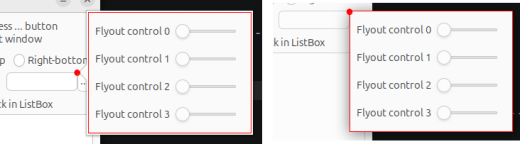
LEFT-TOP alignment on Wayland (left) and X11 (right).Forcing X11 in a modern application. A particular application may not be able to afford Wayland's limitations, needing full control over window positioning on screen. This is possible thanks to XWayland, an X11 compatibility server. X11 can be forced under Wayland environments in different ways:
- Externally, before launching the application, by setting the
GDK_BACKEND=x11environment variable. - From the application's own code, passing the options string
"-gdkbackend=x11"to osmain or osmain_sync (Listing 1) (there is also"-gdkbackend=wayland"to force the opposite). If this option is omitted, NAppGUI will respect the active session (Wayland on modern desktops), or aGDK_BACKENDalready set externally.
osmain(i_create, i_destroy, "-gdkbackend=x11", App)
|
In the unlikely case that a distribution doesn't offer XWayland (X11 over Wayland), it would need to be installed explicitly (Listing 2):
sudo apt-get install xwayland |
#4. High-density displays (HiDPI)
A HiDPI monitor packs many more physical pixels into the same surface than a conventional monitor of the same size (for example, a 27" 5K panel has 4 times the pixels of a 27" 1440p panel). If those extra pixels were used at "1 to 1" size, each interface element would occupy much less physical space and the interface would end up tiny and illegible. To avoid this, the operating system applies a scale factor (for example, 150% or 200%) that spreads several physical pixels across the representation of each interface element (Figure 8): its physical size stays comfortable, but it is now drawn with much more detail, gaining sharpness (Figure 9), (Figure 10).
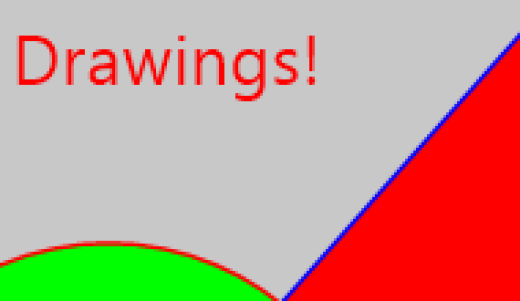
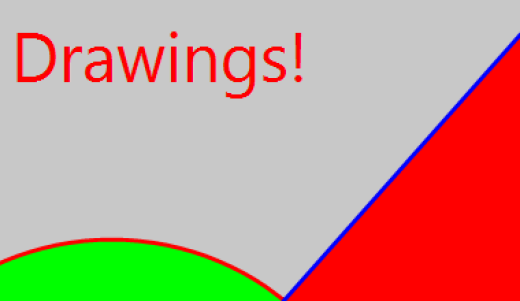
When an application is not prepared for HiDPI, the operating system achieves this same effect in the simplest possible way: it renders the interface at its usual size and then stretches the result through a simple image scaling (bitmap stretching) (Figure 11). The result is an interface with the correct physical size, but visibly blurry, since a low-resolution bitmap is being shown enlarged.
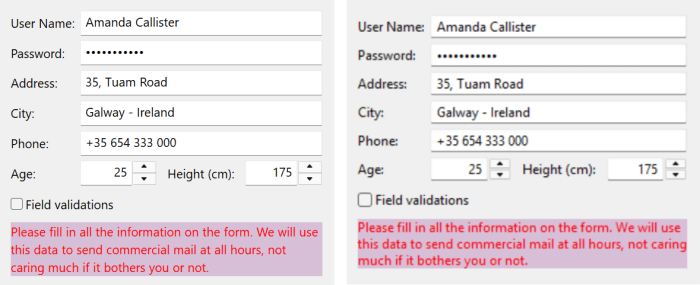
NAppGUI solves this problem at its root: throughout the whole library, positions and sizes are always expressed in logical screen points, never in physical pixels. A logical point equals one physical pixel on a reference monitor (the historical 96 DPI standard on Windows, or a non-Retina Apple screen); on a HiDPI monitor at 200%, for example, each logical point will occupy 2x2 real physical pixels. Thus, a 600x400-point window will keep looking and being programmed as 600x400 on any monitor, while the actual number of pixels used to draw it will vary according to the density of each particular screen. The application doesn't need to perform any special calculation: it just needs to keep positioning and sizing controls as always.
The final conversion to physical pixels happens transparently, at the lowest level of each operating system's backend, right before every native drawing operation or window/control creation. Each backend resolves this step differently, see Native backends.
#5. Internationalization (i18n). Translations
NAppGUI allows translating the interface into multiple languages at runtime, without recompiling or restarting the application. The texts (and also images or files) for each language are grouped into a resource package, registered with gui_respack. To change the active language, just call gui_language from anywhere in the program (Listing 3).
1 2 3 4 5 6 7 8 9 |
static void i_OnLang(App *app, Event *e) { const EvButton *p = event_params(e, EvButton); static const char_t *LANGS[] = { "en_US", "es_ES", "fr_FR" }; gui_language(LANGS[p->index]); } PopUp *popup = popup_create(); popup_OnSelect(popup, listener(app, i_OnLang, App)); |
Changing the interface language brings a new relocation of the elements due to the change in the texts (Figure 12). Gui adapts to these events automatically, recalculating positions and sizes to maintain a consistent layout.
See Resources for a step-by-step guide to localize and translate a complete application.
#6. Theme support (Dark Mode)
Since it uses native controls, windows created with Gui automatically blend in with the light or dark theme active on the system, without needing any extra code. However, if the application defines its own colors or icons, it's worth taking this into account so they stay consistent in both themes.
- There is a set of "system" colors — for example gui_label_color — whose RGB value is resolved at runtime depending on the platform and the active theme. Using them, the application will always look consistent with the rest of the desktop. The Color table demo shows all these colors.
- gui_alt_color allows defining a custom color with two versions — one for light themes and another for dark ones — which Gui will resolve automatically in each case (Listing 4).
- For custom icons or images, both versions must be included in the resources, choosing one or the other depending on gui_dark_mode (Listing 5).
- gui_OnThemeChanged notifies the application when the user switches the system theme on the fly, so custom icons and colors can be updated without restarting the application.
1 |
color_t kHOLDER = gui_alt_color(color_bgr(0x4681Cf), color_bgr(0x1569E6)); |
1 |
button_image(button, gui_dark_mode() ? LOGOUTD_PNG : LOGOUT_PNG); |

#7. GUI Events
Desktop applications are event driven, which means that they are continually waiting for the user to perform some action on the interface: Press a button, drag a slider, write a text, etc. When this occurs, the window manager detects the event and notifies the application (Figure 15), which must provide an event handler with the code to execute. For example in (Listing 6) we define a handler to respond to the press of a button. Obviously, if there is no associated handler, the application will ignore the event.
- Use event_params to obtain the parameters associated with the event. Each type of event has its own parameters. See (Table 3).
- Use event_result to write the response to the event. Very few events require sending a response.
1 2 3 4 5 6 7 8 9 |
static void i_OnClick(App *app, Event *e) { const EvButton *p = event_params(e, EvButton); if (p->state == ekGUI_ON) create_new_file(app); } Button *button = button_check(); button_OnClick(button, listener(app, i_OnClick, App)); |
Sometimes it may be necessary to fire an event while the application is in "standby mode", without processing any other pending events. This occurs when we want to launch a secondary or modal window as a consequence of another event, for example, the pressing of a button. It is advisable, to avoid blocking or unwanted artifacts, to let the first event conclude and schedule the response for a later time, where the application has no pending tasks.
- Use gui_OnIdle to raise an event when there are no other pending tasks.
1 2 3 4 5 6 7 8 9 10 11 |
static void i_OnIdle(App *app, Event *e) { window_modal(app->modal_window, app->main_window); } static void i_OnClick(App *app, Event *e) { // The modal window will be launched after // the OnClick event is totally processed. gui_OnIdle(listener(app, i_OnIdle, App)); } |
| Event | Handler | Parameters | Response |
| Click in label | label_OnClick | EvMouse | - |
| Click on button | button_OnClick | EvButton | - |
| Selection in PopUp | popup_OnSelect | EvButton | - |
| Keystroke or paste | edit_OnFilter | EvText | EvTextFilter |
| End of edit in Edit | edit_OnChange | EvText | bool_t |
| Edit has received or lost keyboard focus | edit_OnFocus | bool_t | - |
| Key press on Combo | combo_OnFilter | EvText | EvTextFilter |
| End of editing in Combo | combo_OnChange | EvText | bool_t |
| Combo has received or lost keyboard focus | combo_OnFocus | bool_t | - |
| Selection in Combo | combo_OnSelect | EvButton | - |
| Selection in Tabs | tabs_OnSelect | EvButton | - |
| A mouse button was pressed | listbox_OnDown | EvMouse | bool_t |
| Selection in ListBox | listbox_OnSelect | EvButton | - |
| Click on UpDown | updown_OnClick | EvButton | - |
| Slider movement | slider_OnMoved | EvSlider | - |
| Draw the contents of a view | view_OnDraw | EvDraw | - |
| Draw the overlay of a view | view_OnOverlay | EvDraw | - |
| The size of a view has changed | view_OnSize | EvSize | - |
| The mouse enters the area of a view | view_OnEnter | EvMouse | - |
| The mouse leaves the area of a view | view_OnExit | - | - |
| The mouse moves over a view | view_OnMove | EvMouse | - |
| A mouse button was pressed | view_OnDown | EvMouse | - |
| A mouse button has been released | view_OnUp | EvMouse | - |
| Click on a view | view_OnClick | EvMouse | - |
| Dragging on a view | view_OnDrag | EvMouse | - |
| Mouse wheel on a view | view_OnWheel | EvWheel | - |
| Press key on a view | view_OnKeyDown | EvKey | - |
| Release key on a view | view_OnKeyUp | EvKey | - |
| View has received or lost keyboard focus | view_OnFocus | bool_t | - |
| View resing keyboard focus | view_OnResignFocus | - | bool_t |
| View accepts keyboard focus | view_OnAcceptFocus | - | bool_t |
| The scroll bars are being manipulated. | view_OnScroll | EvScroll | real32_t |
| Keystroke or paste | textview_OnFilter | EvText | EvTextFilter |
| TextView has received or lost keyboard focus | textview_OnFocus | bool_t | - |
| WebView has received or lost keyboard focus | webview_OnFocus | bool_t | - |
| Close a window | window_OnClose | EvWinClose | bool_t |
| Window moving around the desk | window_OnMoved | EvPos | - |
| Window is re-dimensioning | window_OnResize | EvSize | - |
| Click on an item menu | menuitem_OnClick | EvMenu | - |
| Color change | comwin_color | color_t | - |
| Inactivity | gui_OnIdle | - | - |
#enum gui_orient_t
Orientation.
enum gui_orient_t
{
    ekGUI_HORIZONTAL,
    ekGUI_VERTICAL
};
| ekGUI_HORIZONTAL | Horizontal. |
| ekGUI_VERTICAL | Vertical. |
#enum gui_pos_t
Relative position.
enum gui_pos_t
{
    ekGUI_POS_NONE,
    ekGUI_POS_LEFT,
    ekGUI_POS_TOP,
    ekGUI_POS_RIGHT,
    ekGUI_POS_BOTTOM
};
| ekGUI_POS_NONE | None or default. |
| ekGUI_POS_LEFT | Left. |
| ekGUI_POS_TOP | Top. |
| ekGUI_POS_RIGHT | Right. |
| ekGUI_POS_BOTTOM | Bottom. |
#enum gui_state_t
State values.
enum gui_state_t
{
    ekGUI_OFF,
    ekGUI_ON,
    ekGUI_MIXED
};
| ekGUI_OFF | Off. |
| ekGUI_ON | On. |
| ekGUI_MIXED | Medium/undetermined. |
#enum gui_mouse_t
Mouse buttons.
enum gui_mouse_t
{
    ekGUI_MOUSE_LEFT,
    ekGUI_MOUSE_RIGHT,
    ekGUI_MOUSE_MIDDLE
};
| ekGUI_MOUSE_LEFT | Left. |
| ekGUI_MOUSE_RIGHT | Right. |
| ekGUI_MOUSE_MIDDLE | Center. |
#enum gui_cursor_t
Cursors. See window_cursor.
enum gui_cursor_t
{
    ekGUI_CURSOR_ARROW,
    ekGUI_CURSOR_HAND,
    ekGUI_CURSOR_IBEAM,
    ekGUI_CURSOR_CROSS,
    ekGUI_CURSOR_SIZEWE,
    ekGUI_CURSOR_SIZENS,
    ekGUI_CURSOR_USER
};
| ekGUI_CURSOR_ARROW | Arrow (default). |
| ekGUI_CURSOR_HAND | Hand. |
| ekGUI_CURSOR_IBEAM | Vertical bar (text editing). |
| ekGUI_CURSOR_CROSS | Cross. |
| ekGUI_CURSOR_SIZEWE | Horizontal resize (left-right). |
| ekGUI_CURSOR_SIZENS | Vertical resize (top-bottom). |
| ekGUI_CURSOR_USER | Created from an image. |
#enum gui_close_t
Reason for closing a window.
enum gui_close_t
{
    ekGUI_CLOSE_ESC,
    ekGUI_CLOSE_INTRO,
    ekGUI_CLOSE_BUTTON,
    ekGUI_CLOSE_DEACT
};
| ekGUI_CLOSE_ESC | The |
| ekGUI_CLOSE_INTRO | The |
| ekGUI_CLOSE_BUTTON | The close button |
| ekGUI_CLOSE_DEACT | The main window has been clicked (only received by overlay windows). |
#enum gui_scale_t
Ways of scaling an image.
enum gui_scale_t
{
    ekGUI_SCALE_NONE,
    ekGUI_SCALE_AUTO,
    ekGUI_SCALE_ASPECT,
    ekGUI_SCALE_ASPECTDW,
    ekGUI_SCALE_ADJUST
};
| ekGUI_SCALE_NONE | The image will be displayed centered in the control frame, without scaling. It may not be fully displayed. |
| ekGUI_SCALE_AUTO | The image will be scaled to fit the control frame. Its aspect ratio may change. |
| ekGUI_SCALE_ASPECT | The image will be scaled to fit the control frame, but without changing its aspect ratio. If one of the dimensions (width/height) is smaller than the size of the control, it will be centered. |
| ekGUI_SCALE_ASPECTDW | Same as above, but does not increase the original size, only reduces it if necessary. If any of the dimensions (width/height) is less than the size of the control, it will be centered. |
| ekGUI_SCALE_ADJUST | The size of the control (e.g. |
#enum gui_scroll_t
Types of scroll.
enum gui_scroll_t
{
    ekGUI_SCROLL_BEGIN,
    ekGUI_SCROLL_END,
    ekGUI_SCROLL_STEP_LEFT,
    ekGUI_SCROLL_STEP_RIGHT,
    ekGUI_SCROLL_PAGE_LEFT,
    ekGUI_SCROLL_PAGE_RIGHT,
    ekGUI_SCROLL_THUMB
};
| ekGUI_SCROLL_BEGIN | Jump to start. |
| ekGUI_SCROLL_END | Skip to the end. |
| ekGUI_SCROLL_STEP_LEFT | Jump one step (or line) to the left or up. |
| ekGUI_SCROLL_STEP_RIGHT | Jump one step (or line) to the right or down. |
| ekGUI_SCROLL_PAGE_LEFT | Jump a page to the left or up. |
| ekGUI_SCROLL_PAGE_RIGHT | Jump a page to the right or down. |
| ekGUI_SCROLL_THUMB | Jump to the |
#enum gui_focus_t
Result when changing the keyboard focus.
enum gui_focus_t
{
    ekGUI_FOCUS_CHANGED,
    ekGUI_FOCUS_KEEP,
    ekGUI_FOCUS_NO_NEXT,
    ekGUI_FOCUS_NO_RESIGN,
    ekGUI_FOCUS_NO_ACCEPT
};
| ekGUI_FOCUS_CHANGED | The focus has changed to the specified control. |
| ekGUI_FOCUS_KEEP | The focus has not moved, it remains on the same control. |
| ekGUI_FOCUS_NO_NEXT | Target control not found, hidden, or disabled. |
| ekGUI_FOCUS_NO_RESIGN | The current control does not allow changing focus. |
| ekGUI_FOCUS_NO_ACCEPT | The new control does not accept focus. |
#enum gui_tab_t
Action that has motivated the change of keyboard focus.
enum gui_tab_t
{
    ekGUI_TAB_KEY,
    ekGUI_TAB_BACKKEY,
    ekGUI_TAB_NEXT,
    ekGUI_TAB_PREV,
    ekGUI_TAB_MOVE,
    ekGUI_TAB_CLICK
};
| ekGUI_TAB_KEY | Pressing the |
| ekGUI_TAB_BACKKEY | Pressing |
| ekGUI_TAB_NEXT | Call to window_next_tabstop. |
| ekGUI_TAB_PREV | Call to window_previous_tabstop. |
| ekGUI_TAB_MOVE | Call to window_focus. |
| ekGUI_TAB_CLICK | Click on another control. |
#enum gui_event_t
Event type. See GUI Events.
enum gui_event_t
{
    ekGUI_EVENT_LABEL,
    ekGUI_EVENT_BUTTON,
    ekGUI_EVENT_POPUP,
    ekGUI_EVENT_LISTBOX,
    ekGUI_EVENT_SLIDER,
    ekGUI_EVENT_UPDOWN,
    ekGUI_EVENT_TXTFILTER,
    ekGUI_EVENT_TXTCHANGE,
    ekGUI_EVENT_FOCUS_RESIGN,
    ekGUI_EVENT_FOCUS_ACCEPT,
    ekGUI_EVENT_FOCUS,
    ekGUI_EVENT_MENU,
    ekGUI_EVENT_DRAW,
    ekGUI_EVENT_OVERLAY,
    ekGUI_EVENT_RESIZE,
    ekGUI_EVENT_ENTER,
    ekGUI_EVENT_EXIT,
    ekGUI_EVENT_MOVED,
    ekGUI_EVENT_DOWN,
    ekGUI_EVENT_UP,
    ekGUI_EVENT_CLICK,
    ekGUI_EVENT_DRAG,
    ekGUI_EVENT_WHEEL,
    ekGUI_EVENT_KEYDOWN,
    ekGUI_EVENT_KEYUP,
    ekGUI_EVENT_SCROLL,
    ekGUI_EVENT_WND_MOVED,
    ekGUI_EVENT_WND_SIZING,
    ekGUI_EVENT_WND_SIZE,
    ekGUI_EVENT_WND_CLOSE,
    ekGUI_EVENT_COLOR,
    ekGUI_EVENT_THEME,
    ekGUI_EVENT_OBJCHANGE,
    ekGUI_EVENT_TBL_NROWS,
    ekGUI_EVENT_TBL_BEGIN,
    ekGUI_EVENT_TBL_END,
    ekGUI_EVENT_TBL_CELL,
    ekGUI_EVENT_TBL_SEL,
    ekGUI_EVENT_TBL_HEADCLICK,
    ekGUI_EVENT_TBL_ROWCLICK,
    ekGUI_EVENT_TBL_NCHILDREN,
    ekGUI_EVENT_TBL_NODEINFO,
    ekGUI_EVENT_TBL_EXPAND
};
| ekGUI_EVENT_LABEL | Click on a Label control. |
| ekGUI_EVENT_BUTTON | Click on a Button control. |
| ekGUI_EVENT_POPUP | The selection of a PopUp control has been changed. |
| ekGUI_EVENT_LISTBOX | The selection of a control has been changed ListBox. |
| ekGUI_EVENT_SLIDER | You are moving an Slidercontrol. |
| ekGUI_EVENT_UPDOWN | Click on a UpDown control. |
| ekGUI_EVENT_TXTFILTER | |
| ekGUI_EVENT_TXTCHANGE | You have finished editing the text of a Edit or Combo control. |
| ekGUI_EVENT_FOCUS_RESIGN | Ask a control if it wants to give up keyboard focus. |
| ekGUI_EVENT_FOCUS_ACCEPT | Ask a control if it wants to accept keyboard focus. |
| ekGUI_EVENT_FOCUS | A control has received or lost keyboard focus. |
| ekGUI_EVENT_MENU | Click on a menu. |
| ekGUI_EVENT_DRAW | The view content must be redrawn. |
| ekGUI_EVENT_OVERLAY | There is draw the overlay layer. |
| ekGUI_EVENT_RESIZE | The size of a view has changed. |
| ekGUI_EVENT_ENTER | The mouse has entered the view area. |
| ekGUI_EVENT_EXIT | The mouse has left the view area. |
| ekGUI_EVENT_MOVED | The mouse is moving on the view surface. |
| ekGUI_EVENT_DOWN | A mouse button was pressed. |
| ekGUI_EVENT_UP | A mouse button has been released. |
| ekGUI_EVENT_CLICK | Click on a view. |
| ekGUI_EVENT_DRAG | Dragging is being done over. |
| ekGUI_EVENT_WHEEL | Mouse wheel has moved. |
| ekGUI_EVENT_KEYDOWN | A key has been pressed. |
| ekGUI_EVENT_KEYUP | A key has been released. |
| ekGUI_EVENT_SCROLL | The scroll bars are being manipulated. |
| ekGUI_EVENT_WND_MOVED | The window is moving across the desktop. |
| ekGUI_EVENT_WND_SIZING | The window is being resized. |
| ekGUI_EVENT_WND_SIZE | The window has been resized. |
| ekGUI_EVENT_WND_CLOSE | The window has been closed. |
| ekGUI_EVENT_COLOR | An update color of comwin_color. |
| ekGUI_EVENT_THEME | Desktop theme has changed. |
| ekGUI_EVENT_OBJCHANGE | An object linked to a layout has been edited. Notifications and calculated fields. |
| ekGUI_EVENT_TBL_NROWS | A table needs to know the number of rows. |
| ekGUI_EVENT_TBL_BEGIN | A table will begin to draw the visible part of the data. |
| ekGUI_EVENT_TBL_END | A table has finished drawing. |
| ekGUI_EVENT_TBL_CELL | A table needs the data of a cell. |
| ekGUI_EVENT_TBL_SEL | The selected rows in a table have changed. |
| ekGUI_EVENT_TBL_HEADCLICK | Click on a table header. |
| ekGUI_EVENT_TBL_ROWCLICK | Click on a table row. |
| ekGUI_EVENT_TBL_NCHILDREN | A tree-mode table needs to know the number of node children. |
| ekGUI_EVENT_TBL_NODEINFO | A tree-mode table requests information about a specific node. |
| ekGUI_EVENT_TBL_EXPAND | The user has expanded or collapsed a node in a tree-mode table. |
#enum split_mode_t
Behavior of the divider in a SplitView.
enum split_mode_t
{
    ekSPLIT_NORMAL,
    ekSPLIT_FIXED0,
    ekSPLIT_FIXED1
};
| ekSPLIT_NORMAL | The divider maintains its left/right or up/down proportional position. |
| ekSPLIT_FIXED0 | The left/upper child maintains its size. |
| ekSPLIT_FIXED1 | The right/lower child maintains its size. |
#enum window_flag_t
Window creation attributes.
enum window_flag_t
{
    ekWINDOW_FLAG,
    ekWINDOW_EDGE,
    ekWINDOW_TITLE,
    ekWINDOW_MAX,
    ekWINDOW_MIN,
    ekWINDOW_CLOSE,
    ekWINDOW_RESIZE,
    ekWINDOW_RETURN,
    ekWINDOW_ESC,
    ekWINDOW_MODAL_NOHIDE,
    ekWINDOW_STD,
    ekWINDOW_STDRES
};
| ekWINDOW_FLAG | Default attributes. |
| ekWINDOW_EDGE | The window draws an outer border. |
| ekWINDOW_TITLE | The window has a title bar. |
| ekWINDOW_MAX | The window shows the maximize button. |
| ekWINDOW_MIN | The window shows the minimize button. |
| ekWINDOW_CLOSE | The window shows the close button. |
| ekWINDOW_RESIZE | The window has resizable borders. |
| ekWINDOW_RETURN | The window will process the pressing of the [RETURN] key as a possible closing event, sending the message OnClose. |
| ekWINDOW_ESC | The window will process the pressing of the [ESC] key as a possible closing event, sending the message OnClose. |
| ekWINDOW_MODAL_NOHIDE | Avoids hiding a modal window when the modal cycle has finished. See Modal windows. |
| ekWINDOW_STD | Combination |
| ekWINDOW_STDRES | Combination |
#enum gui_notif_t
Notifications sent by the gui library.
enum gui_notif_t
{
    ekGUI_NOTIF_LANGUAGE,
    ekGUI_NOTIF_WIN_DESTROY,
    ekGUI_NOTIF_MENU_DESTROY
};
| ekGUI_NOTIF_LANGUAGE | The interface language has been changed. |
| ekGUI_NOTIF_WIN_DESTROY | A window has been destroyed. |
| ekGUI_NOTIF_MENU_DESTROY | A menu has been destroyed. |
#struct GuiControl
Interface Control (abstract).
struct GuiControl;
#struct Label
Interface control that contains static text, usually limited to a single line. Label.
struct Label;
#struct Button
Interface control representing a button. Button.
struct Button;
#struct PopUp
Control button with drop-down list. PopUp.
struct PopUp;
#struct Edit
Text editing control Edit.
struct Edit;
#struct Combo
Control that combines an edit box with a drop-down list. Combo.
struct Combo;
#struct Tabs
Control that displays several selection tabs. Tabs.
struct Tabs;
#struct ListBox
List control. ListBox.
struct ListBox;
#struct UpDown
Control that shows two small increase and decrease buttons. UpDown.
struct UpDown;
#struct Slider
Control that shows a bar with a slider. Slider.
struct Slider;
#struct Progress
Progress bar. Progress.
struct Progress;
#struct View
Custom View that allows to create our own controls, drawing what we want. View
struct View;
#struct TextView
Text view with several paragraphs and different attributes. TextView.
struct TextView;
#struct WebView
Web content view. WebView.
struct WebView;
#struct ImageView
Image viewer control. ImageView.
struct ImageView;
#struct TableView
Table view with multiple rows and columns. TableView.
struct TableView;
#struct SplitView
Resizable horizontal or vertical split view. SplitView.
struct SplitView;
#struct Layout
Invisible grid where the controls of a Panel are organized. Layout.
struct Layout;
#struct Cell
Each of the cells that form a Layout. Cell.
struct Cell;
#struct Panel
Internal area of a window, which allows you to group different controls. Panel.
struct Panel;
#struct Line
Separator lines. Line.
struct Line;
#struct Window
Interface window. Window.
struct Window;
#struct Menu
Menu or submenu. Menu.
struct Menu;
#struct MenuItem
Item within a menu. MenuItem.
struct MenuItem;
#struct EvButton
Parameters of the OnClick event of a button or OnSelect of a popup.
struct EvButton
{
    uint32_t index;
    gui_state_t state;
    const char_t* text;
};
| index | Button or item index. |
| state | State. |
| text | Text. |
#struct EvSlider
Parameters of the OnMoved event of a slider.
struct EvSlider
{
    real32_t pos;
    real32_t incr;
    uint32_t step;
};
| pos | Normalized slider position (0, 1). |
| incr | Increase with respect to the previous position. |
| step | Interval index (only for discrete ranges). |
#struct EvText
Parameters of the OnChange or OnFilter event of the text boxes.
struct EvText
{
    const char_t* text;
    uint32_t cpos;
    int32_t len;
};
| text | Text. |
| cpos | Cursor position (caret). |
| len | In OnFilter, the amount of characters inserted or removed. In OnChange the total number of characters. |
#struct EvTextFilter
Result of the OnFilter event of the text boxes.
struct EvTextFilter
{
    bool_t apply;
    char_t* text;
    uint32_t cpos;
};
| apply |
|
| text | New control text, which is a revision (filter) of the original text. |
| cpos | Cursor position (caret). |
#struct EvDraw
OnDraw event parameters.
struct EvDraw
{
    DCtx* ctx;
    real32_t x;
    real32_t y;
    real32_t width;
    real32_t height;
};
| ctx | 2D drawing context. |
| x | X coordinate of the drawing area (viewport). |
| y | Y coordinate of the drawing area. |
| width | Width of the drawing area. |
| height | Height of the drawing area. |
#struct EvMouse
Mouse event parameters.
struct EvMouse
{
    real32_t x;
    real32_t y;
    real32_t lx;
    real32_t ly;
    gui_mouse_t button;
    uint32_t count;
    uint32_t modifiers;
    uint32_t tag;
};
| x | X coordinate of the pointer in the drawing area. |
| y | Y coordinate of the pointer in the drawing area. |
| lx | X coordinate of the pointer on the control. Same as |
| ly | Y coordinate of the pointer on the control. Same as |
| button | Active button. |
| count | Number of clicks. |
| modifiers | Combination of values mkey_t. |
| tag | Additional value for controls. |
#struct EvWheel
OnWheel event parameters.
struct EvWheel
{
    real32_t x;
    real32_t y;
    real32_t dx;
    real32_t dy;
    real32_t dz;
};
| x | Pointer x coordinate. |
| y | Pointer y coordinate. |
| dx | Increase in x of the wheel or trackpad. |
| dy | Increase in x of the wheel or trackpad. |
| dz | Increase in x of the wheel or trackpad. |
#struct EvKey
Keyboard event parameters.
struct EvKey
{
    vkey_t key;
    uint32_t modifiers;
};
| key | Referenced key. |
| modifiers | Combination of values mkey_t. |
#struct EvPos
Parameters of change of position events.
struct EvPos
{
    real32_t x;
    real32_t y;
};
| x | X coordinate. |
| y | Y coordinate. |
#struct EvSize
Resize event parameters.
struct EvSize
{
    real32_t width;
    real32_t height;
};
| width | Width (size in x). |
| height | Height (size in y). |
#struct EvWinClose
Window closing Event Parameters.
struct EvWinClose
{
    gui_close_t origin;
};
| origin | Origin of the close. |
#struct EvMenu
Menu event parameters.
struct EvMenu
{
    uint32_t index;
    gui_state_t state;
    const char_t* text;
};
| index | Pressed item index. |
| state | Pressed item status. |
| text | Pressed item text. |
#struct EvScroll
Scroll event parameters.
struct EvScroll
{
    gui_orient_t orient;
    gui_orient_t scroll;
    real32_t cpos;
};
| orient | Scroll bar orientation. |
| scroll | Scroll type. |
| cpos | Scroll position. |
#struct EvTbPos
Location of a cell in a table.
struct EvTbPos
{
    uint32_t col;
    uint32_t row;
    void* node;
};
| col | Column index. |
| row | Row index. In tree mode, indicates the physical position of the node in the visible table. |
| node | In tree mode, pointer to the node of the current row. |
#struct EvTbRow
Location of a row in a table.
struct EvTbRow
{
    bool_t sel;
    uint32_t row;
};
| sel | Selected or not. |
| row | Row index. |
#struct EvTbRect
Group of cells in a table.
struct EvTbRect
{
    uint32_t stcol;
    uint32_t edcol;
    uint32_t strow;
    uint32_t edrow;
};
| stcol | Initial column index. |
| edcol | End column index. |
| strow | Initial row index. |
| edrow | End row index. |
#struct EvTbSel
Selection in a table.
struct EvTbSel
{
    ArrSt(uint32_t)* sel;
};
| sel | Row indices. |
#struct EvTbCell
Data from a cell in a table.
struct EvTbCell
{
    const char_t* text;
    align_t align;
};
| text | Cell text. |
| align | Text alignment. |
#struct EvTbNode
Request for a node in tree mode. Parameters of the ekGUI_EVENT_TBL_NODEINFO event.
struct EvTbNode
{
    void* parent;
    uint32_t ichild;
};
| parent | Pointer to the parent node, or |
| ichild | Index of the child within the parent (0-based). |
#struct EvTbNodeInfo
Information about a node in tree mode. Result of the ekGUI_EVENT_TBL_NODEINFO event.
struct EvTbNodeInfo
{
    void* node;
    bool_t children;
    bool_t expanded;
};
| node | Application pointer that identifies the node. |
| children |
|
| expanded |
|
#struct EvTbExpand
Expansion or contraction notification in tree mode. Parameters of the ekGUI_EVENT_TBL_EXPAND event.
struct EvTbExpand
{
    void* node;
    bool_t expanded;
};
| node | Application pointer that identifies the node. |
| expanded |
|
#struct FocusInfo
Information about changing the keyboard focus.
struct FocusInfo
{
    gui_tab_t action;
    GuiControl* next;
};
| action | Action that has motivated the change of keyboard focus. |
| next | Next control that will receive keyboard focus. |
#gui_start ()
Start the Gui library, reserving space for global internal structures. Internally call draw2d_start. It is called automatically by osmain.
void
gui_start(void);
#gui_finish ()
Finish the Gui library, freeing up the space of global internal structures. Internally call draw2d_finish. It is called automatically by osmain.
void
gui_finish(void);
#gui_dpi_aware ()
Enables or disables adapting the interface to the monitor's real resolution (DPI). If needed, it must be called before creating the application's first window.
void
gui_dpi_aware(const bool_t aware);
| aware |
|
Remarks
Only has effect on Windows. On macOS and Linux the interface always adapts natively to the monitor's resolution.
#gui_respack ()
Register a resource package.
void
gui_respack(FPtr_respack func_respack);
| func_respack | Resource constructor. |
Remarks
See Internationalization (i18n). Translations and Resources.
#gui_language ()
Set the language of the registered resources with gui_respack.
void
gui_language(const char_t *lang);
| lang | Language. |
Remarks
See Internationalization (i18n). Translations and Resources.
#gui_text ()
Get a text string through its resource identifier.
const char_t*
gui_text(const ResId id);
| id | Resource Identifier. |
Return
The text string or NULL if it is not found.
Remarks
The resource must belong to a package registered with gui_respack. See Internationalization (i18n). Translations.
#gui_image ()
Get an image through its resource identifier.
const Image*
gui_image(const ResId id);
| id | Resource Identifier. |
Return
The image or NULL if it is not found.
Remarks
The resource must belong to a package registered with gui_respack. Do not destroy the image as it is managed by Gui. See Internationalization (i18n). Translations.
#gui_file ()
Get the contents of a file through its resource identifier.
const byte_t*
gui_file(const ResId id,
         uint32_t *size);
| id | Resource Identifier. |
| size | Buffer size in bytes. |
Return
File data or NULL if it is not found.
Remarks
The resource must belong to a package registered with gui_respack. The data is managed by Gui, so there is no need to free memory. See Internationalization (i18n). Translations.
#gui_dark_mode ()
Determines if the window environment has a light or dark theme.
bool_t
gui_dark_mode(void);
Return
TRUE for Dark mode, FALSE for light mode.
Remarks
See Theme support (Dark Mode).
#gui_alt_color ()
Create a color with two alternative versions.
color_t
gui_alt_color(const color_t light_color,
              const color_t dark_color);
| light_color | Color for LIGHT desktop themes. |
| dark_color | Color for DARK desktop themes. |
Return
The color.
Remarks
The system will set the final color based on the "lightness" of the window manager colors (Light/Dark). Nested alternate colors ARE NOT ALLOWED. The light and dark values must be RGB or system colors. See Theme support (Dark Mode).
#gui_label_color ()
Returns the default color of text labels Label.
color_t
gui_label_color(void);
Return
The color.
Remarks
See Theme support (Dark Mode).
#gui_view_color ()
Returns the background color in controls View.
color_t
gui_view_color(void);
Return
The color.
Remarks
See Theme support (Dark Mode).
#gui_line_color ()
Returns the color of lines in tables or window separator elements.
color_t
gui_line_color(void);
Return
The color.
Remarks
See Theme support (Dark Mode).
#gui_link_color ()
Returns the color of the text in hyperlinks.
color_t
gui_link_color(void);
Return
The color.
Remarks
See Theme support (Dark Mode).
#gui_border_color ()
Returns the border color in button controls, popups, etc..
color_t
gui_border_color(void);
Return
The color.
Remarks
See Theme support (Dark Mode).
#gui_device ()
Returns the device type.
device_t
gui_device(void);
Return
Device.
#gui_resolution ()
Returns screen resolution.
S2Df
gui_resolution(void);
Return
Resolution.
#gui_workarea ()
Returns the useful work area, that is, the screen resolution removing the space occupied by the Dock, taskbar, menus, etc.
R2Df
gui_workarea(void);
Return
Work area.
Remarks
On Wayland it returns the full monitor resolution, without excluding the Dock or panels: the protocol does not expose that information to clients. See Wayland support.
#gui_mouse_pos ()
Returns the position of the mouse cursor.
V2Df
gui_mouse_pos(void);
Return
Position.
Remarks
On Wayland it cannot return a real, precise screen position, since the protocol does not expose that information to clients. See Wayland support.
#gui_update ()
Refreshes all application windows, after a theme or scrollbar style change.
void
gui_update(const bool_t theme,
           const bool_t scrollers);
| theme |
|
| scrollers |
|
Remarks
Normally it is not necessary to call this method. It is called automatically from osapp.
#gui_OnThemeChanged ()
Set a handler to detect the change of the visual theme of the windows environment.
void
gui_OnThemeChanged(Listener *listener);
| listener | The event handler. |
Remarks
See Theme support (Dark Mode).
#gui_update_transitions ()
Update the automatic animations of the interface.
void
gui_update_transitions(const real64_t prtime,
                       const real64_t crtime);
| prtime | Time of the previous instant. |
| crtime | Time of the current instant. |
Remarks
Normally it is not necessary to call this method. It is called automatically from osapp.
#gui_OnNotification ()
Sets up a handler to receive notifications from gui.
void
gui_OnNotification(Listener *listener);
| listener | The event handler. |
Remarks
See gui_notif_t.
#gui_OnIdle ()
Sets a handler to raise an event when the application is in "standby mode".
void
gui_OnIdle(Listener *listener);
| listener | The event handler. |
Remarks
The event will be raised once when the application's message loop is idle, that is, not processing other pending events. See GUI Events.
#gui_info_window ()
Displays an information window about the execution of the program. It is aimed at displaying anomaly messages or debugging messages. Do not use for user information.
uint32_t
gui_info_window(const bool_t fatal,
                const char_t *msg,
                const char_t *caption,
                const char_t *detail,
                const char_t *file,
                const uint32_t line,
                const ArrPt(String) *buttons,
                const uint32_t defindex);
1 2 3 4 5 6 7 8 |
uint32_t sel = 0; ArrPt(String) *buttons = arrpt_create(String); arrpt_append(buttons, str_c("Ok"), String); arrpt_append(buttons, str_c("Bye"), String); arrpt_append(buttons, str_c("Forget"), String); arrpt_append(buttons, str_c("Ask again"), String); sel = gui_info_window(TRUE, "Here an info window", "Something happens", "You do something wrong\nin the file passed as 'stream' parameter.", "your_file.txt", 43, buttons, 1); arrpt_destroy(&buttons, str_destroy, String); |
| fatal |
|
| msg | Summary message. |
| caption | Title, |
| detail | Detailed message. Supports '\n'. |
| file | File related to the message. |
| line | Line related to the message. |
| buttons | Buttons. |
| defindex | Default button. |
Return
Button number pressed.
#evbind_object ()
Gets the object linked to a layout within a callback function.
type*
evbind_object(Event *e,
              type);
| e | The event. |
| type | The object type. |
Return
The object.
Remarks
See Notifications and calculated fields.
#evbind_modify ()
Checks, inside a callback function, if the object's field has been modified.
bool_t
evbind_modify(Event *e,
              type,
              mtype,
              mname);
| e | The event. |
| type | The object type. |
| mtype | The type of the field to check. |
| mname | The name of the field to check. |
Return
TRUE if the field has been modified.
Remarks
See Notifications and calculated fields.